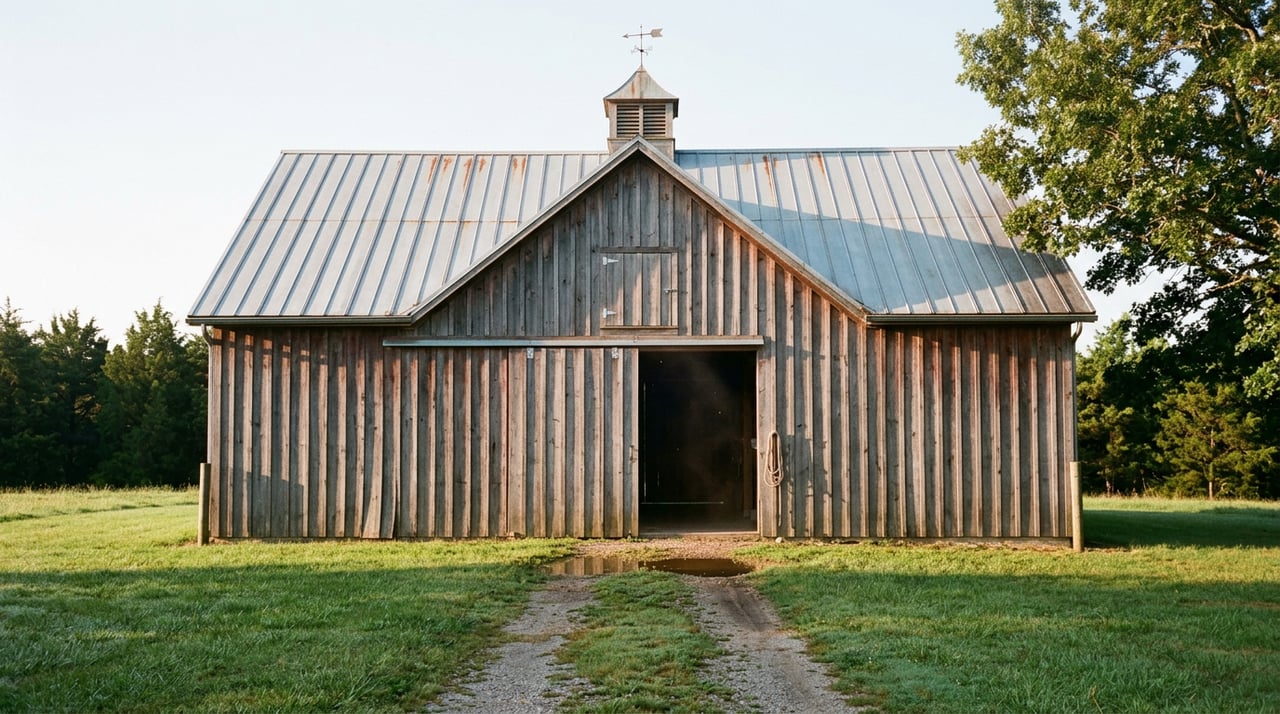
Which Shelbyville are you pricing? That question sounds strange until you actually try to compare a listing on the square to a listing ten minutes outside town with a barn on it. The two numbers do not belong to the same market, even though they share a zip code, and the gap between them is the thing worth understanding before the Tennessee Walking Horse National Celebration fills every hotel room in Bedford County again this August.
The Celebration runs August 26 through September 5 this year, the 88th annual running of a show that started in 1939 and closes with the crowning of the World Grand Champion on the Saturday night before Labor Day. It still draws an estimated 250,000 spectators to a town that Shelbyville native Warren Wells describes as smaller than the arena itself. A single night at the outdoor arena seats 30,000 people. The town holds around 25,000.
That mismatch is a fun fact until you connect it to land prices, and then it explains something the median doesn't.
The Number Everyone Quotes First
If you pull up Bedford County housing data right now, the county-wide median sale price sits at $380,000 as of February 2026, up 18.8 percent year over year, with homes taking an average of 114 days to sell, compared to 92 days the year before. That's a county-level number, and it flattens five very different towns into one line.
Break it apart by city and Shelbyville is actually the affordable end of Bedford County. Recent countywide figures put the average Shelbyville house price around $324,990, the lowest of the county's cities, while Bell Buckle carries the highest median listing price in the county at $474,950. A buyer shopping "Shelbyville real estate" with that number in hand is shopping correctly, as long as they mean a house.
The Other Number Nobody Puts Next To It
Search for horse property in Shelbyville instead of houses and the picture flips. As of mid-July 2026, there were 21 equestrian properties listed for sale near Shelbyville, averaging $947,533 per listing and roughly $42,446 per acre. That's not a typo next to the $324,990 residential average. It's almost three times it, on the same map, inside the same city limits.
Widen the lens to Bedford County farm listings generally and the acreage math holds the same shape: recent farm listings across the county totaled roughly 1,000 acres at a combined value near $24 million, an average price near $1 million per farm.
Here's what that looks like side by side.
| Typical Shelbyville home | Shelbyville-area equestrian property | |
|---|---|---|
| Average price | $324,990 | $947,533 |
| What sets the price | Square footage, lot size, condition | Acreage, barns, arenas, fencing, riding infrastructure |
| County comparison | Lowest average among Bedford County cities | Comparable to premium farm listings countywide |
A buyer who anchors on the town's low residential average and then goes looking for five acres and a barn is going to feel like the market moved on them. It didn't. They just crossed from one pricing system into another without noticing the line.
What The Celebration Actually Buys
It's tempting to blame the horse-property premium on the Celebration itself, as if two weeks of national attention every August inflates what land costs the other fifty. The numbers don't support that story either.
Warren Wells told WKRN this year:
"It's a Tennessee tradition. It's made it through world wars. We've been going on for 88 years straight."
The Celebration is held at the Celebration Grounds, a complex spanning over 100 acres with 60 barns and 1,650 stalls, drawing an estimated 2,000 horses across the run of the show. The arena that hosts the biggest nights, formerly known as the Calsonic Arena, was rebranded Cooper Steel Arena and has gone through exterior and interior updates in recent years. None of that infrastructure gets built for eleven days and mothballed for the other 354. It has to be maintained, staffed, and boarded year-round, and that year-round demand for barns, trainers, farriers, and pasture is what actually prices the acreage market, not a two-week spike in August.
Estimates of the event's annual economic impact vary by source, from $41 million in revenue by one account to a broader estimated $50 million impact to Bedford County and surrounding areas by another. Either figure describes the same underlying fact: this is a full-year industry with a two-week public showcase, not a seasonal event that happens to leave land prices high the rest of the year.
Why Timing Around The Celebration Doesn't Work
Some buyers assume they can time a purchase around the event, either grabbing acreage cheap right before the crowds arrive or waiting for a post-Celebration lull to negotiate. The county's own numbers argue against both theories. Days on market lengthened from 92 to 114 over the past year, and prices still rose 18.8 percent over that same window. That's not a market softening around an event calendar. That's a market where the equestrian segment holds its value regardless of when you show up, because the underlying demand isn't tourist demand. It's operational demand from an industry that never actually leaves.
What This Means If You're Comparing Bedford County Towns
If you're cross-shopping Shelbyville against Manchester or Winchester, the honest comparison depends entirely on which Shelbyville market you're pricing against theirs. Compare residential medians and Shelbyville reads as the value option in Bedford County. Compare acreage with equestrian infrastructure and Shelbyville reads as a premium market shaped by 88 years of continuous investment in horse facilities that most nearby towns never built.
That distinction matters most for exactly the kind of property this brand handles directly: a working farm, a piece of land with a barn already on it, or an estate that includes both a house and acreage. Pricing that kind of property off the county median, or off a competing town's residential comps, misses the segment it actually belongs to. The Celebration didn't create that segment. It's the visible tip of infrastructure that's been priced into the land for decades.
A Few Questions Worth Answering Directly
Does land near Shelbyville get cheaper right after the Celebration ends? The county's own trend lines say no. Days on market lengthened over the past year while prices still climbed, which is the opposite of what you'd expect if the event were propping up a seasonal bubble that deflates in September.
Is every acre in Bedford County priced like horse property? No. The equestrian premium applies to properties marketed and improved for that use, with barns, fencing, and riding infrastructure already in place. Plain acreage without that infrastructure prices closer to general farmland value, not the $42,446-per-acre equestrian average.
Why does Bell Buckle out-price Shelbyville on the residential side if Shelbyville hosts the event? The Celebration's economic activity concentrates in the equestrian and hospitality segments around the event, not in the general housing stock. Bell Buckle's higher residential median reflects its own small-town housing supply and demand, independent of which town holds the horse show.
If you're weighing a house against acreage in Bedford County, or trying to figure out whether a farm listing is priced fairly against what the equestrian market actually supports, that's a conversation worth having with someone who prices both sides of this market regularly. Mike Winton Realty & Auction works residential sales and farm, land, and estate transactions across Bedford, Coffee, Franklin, and the surrounding counties, and can walk you through which comps actually apply to the property you're looking at. Buy, sell, or auction, the first step is knowing which market you're really standing in.